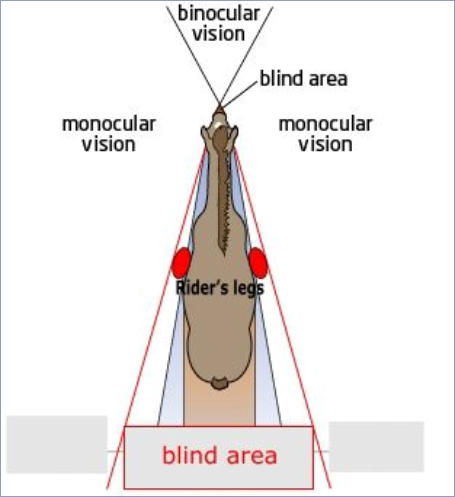
Horses are sensitive to their surroundings using smell, sound, feel and vision; they detect movement under foot and have good hearing but although they can see perfectly well, the blind spot of a horse is huge. They will often tell us that something is ahead before we can see it ourselves. It is usually the case of surprise that makes horse and rider jump, the recognised term is ‘spook’. A horse can spook at a pigeon flying out of a tree or cows behind a hedge. Sometimes it can be something they have walked past many times before or seemingly nothing at all.As riders we do our best to stay safe on the roads and it is relatively easy to control your horse when a noisy motorbike comes along or we can see or hear a tractor approaching, we collect our horse and calmly control them until the vehicle has passed safely, or we signal for them to slow down while we find a safe place to pull off the road and allow them to pass. Cyclists however, can be a silent group who creep up from behind with little to no warning. The blind spot of the horse is much bigger than most people realise; the diagram below shows how extensive this area is and clearly makes it easy to understand why a horse can’t see you until you are practically level with its head. By which time, it may well spook and jump sideways, bolt forwards or it may even spin around so it can get a better look at whatever has frightened it. The diagram shows the blind spots of a horse. If you are in these blind spots the horse won’t see you. Think about how you get a shock if someone walks past you at speed on the street when you didn’t hear them behind you. Now think of the fear a horse, whose natural instincts are to flee for its life, will react.
What you can do to help
As you approach a horse from behind, please let us know you are there by calling out “hello!” or “bike behind!” or “coming up” anything (nice!) that will alert us that you are there. We can take measures to alert our horse you are there and we recommend you take a wide berth, slowing down to a walking crawl and making sure it is safe to overtake. In large groups, consider thinning out so as not to bombard the horse with so many bikes at one time, or slow your group down to give the rider time to pull in somewhere safe. NEVER pass a horse on the left hand side which could trap you between a hedge and the horse or cause the horse to spook into on-coming traffic. If you are coming from in front, please still call out so the horse knows your not a threat and slow down. If cycle races are being held on country roads, ask the organisers to put notices out a couple of days before so that riders can avoid riding on that day or on that route. There is nothing more terrifying than a group of 20-30 cyclists whizzing past, horses can kick out when frightened and can pack a mighty punch. Mountain bikers should be aware of what trails allow horses and if horses are spotted in the area be mindful not to cross over a path without slowing and checking the way is clear first.
Walkers and runners
•As you approach a horse from behind, please let us know you are there by calling out “hello” or “coming past” or softly beginning to talk and say anything (nice!) that will alert us that you are there. We can take measures to alert our horse you are there and we recommend you take a wide berth, making sure it is safe to overtake. •If you are in front of the horse approaching please ask the rider is it okay to continue running/walking past or would if it be better to stand aside and let them walk their horse past. On narrow lanes it is mostly easier for the pedestrian to stand aside as horses won’t be able to move over into the hedges or onto a verge as effectively but be sure the horse has seen you first and sees you stand aside so it doesn’t get a surprise when it walks past you in the hedge.•The rider should talk calmly to the horse and if necessary dismount to pass people. Talk to the rider and the horse also, so they both know you are not a threat. •If you have a dog with you ensure it has good recall or is kept on a lead and doesn’t come near the horse. Horses will defend themselves against dogs and your dog could end up seriously hurt. You will be liable for any damages your dog does to a horse if it is out of your control and could even face legal charges.
Meeting Horses On The Beach
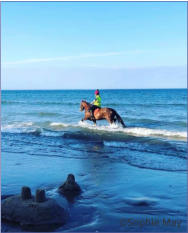
Riding on the beach is possibly one of a riders favourite things to do. There is a lot of space and it is a safe level surface to let our horses have a good run without the need to slow or turn. However it is important that everyone stays safe on the beach. If a walker arrives at the beach and there is a horse-box or signs of horses (e.g. droppings) you must take extra caution. Keep your children and pets close and look along the beach before going onto it. If the riders are moving fast along the beach try to keep as far away as possible. If they are out of control or behaving in an inappropriate manner you are within your rights to call the police or beach warden. Riders should be aware that they are only allowed on the beach at allocated times of the year, which will be dictated by your local council or environmental body. Check when these are, as they are in place for the safety of other beach users. Riders should never go faster than walk when riding near to an entrance and should stay several feet away to allow others to come onto the beach. Riders: if other horses are on the beach remember your manners and do not gallop past them as you may cause someone a lot of stress.
Dog owners
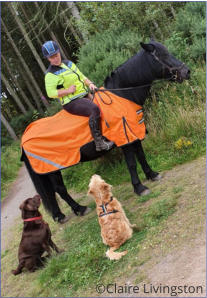
Anyone who owns a dog knows how much fun they have running free in the fields or along a path. Seeing them have fun and get good exercise make us happy too. Horse riders feel the same about their horses. Horses are an animal that spends up to 18 hours a day on the move and due to domestication they sometimes are not able to, this is why having a good run is necessary. It is also very enjoyable. However if both parties are to have a safe and enjoyable time exercising, there are a few things we need to look at. Horses are primarily a flight animal, but if cornered or attacked can fight back with force. Fleeing (or “bolting”) will occur if the threat is far enough away that the horse thinks it has a chance of escape. A horse bolting will not consider roads, barbed wire fence, ditches or the fact that its rider may be a young child or adult who will come off and get seriously injured. Fighting usually occurs if something appears suddenly, or is already too close for the horse to run away from. The horse may spin and kick out with its hind legs, rear up and come down upon or bite at its perceived threat. All of these actions can kill even the largest of predator animals in a short time, so even a large dog is at great risk. If you are close to your dog at this time, you are likely to get injured too. Dogs have been man’s best for thousands of years, but it is important to know why. Dogs were used primarily for hunting down large prey animals and guarding from large predators. This trait has never left dogs which means all dogs have the ability and the courage to go after a large animal and attempt to bring it down or drive it off from their masters, no matter how small they are themselves. However some more timid dogs have the opposite reaction and won’t consider environmental dangers like roads when running in fear, just like a horse.When a dog sees a horse the most common reactions tend to be:•Running away in fear•Barking at the horse and circling it•Chasing the horse•Biting its tail and legs•Generally getting too close to its legs•Trying to bite at its chest, head/neck or stomach•In a pack of two or more dogs, they will generally aim for different areas of the horseAll of these actions can result in death or injury to the dog, the horse and/or rider and potentially other walkers. Some dogs are fine with horses, and enjoy going out with them on a ride, but if you have not desensitised your dog to horses you may find recalling them difficult.
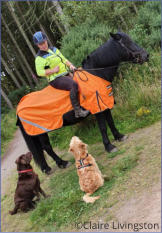
Fortunately there are a few easy steps you can take to ensure your dog or horse is less likely to be injured in an encounter.For horse owners:•Socialise your horse with dogs from a young age•Practice the steps needed to stop or slow your horse if it is fleeing (ask your instructor for advice) •Always wear body protection on a bridleway or somewhere you expect dogs to be•Always wear fluorescent clothing so a dog walker can spot you sooner•Have tags on both yourself and your horse with an ID, any medical problems and a contact telephone number•Be polite and considerate to walkers, thank them if they call or hold their dogs back and ALWAYS slow down to go past themFor dog owners:•Get your dog used to large animals from a young age•Practice good re-call with your dog or keep them on a training/retractable lead •Carry a bag of treats or a favourite toy of the dogs to help distract it•Consider wearing florescent clothing so a rider can spot you sooner•Have tags on your dog with ID and a contact telephone number in case it flees •Be polite and considerate to riders, thank them for slowing •Make sure your dog is focused on you and is not going to run back after the horse even if it has passed
Other Pets
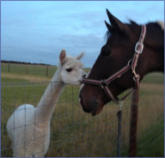
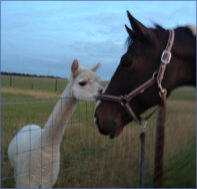
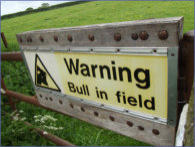
Now days people like to have all sorts of pets from birds to reptiles to llamas. Keeping them safe is a priority, but making sure they don’t put anyone else at danger should also be considered. Llamas/Alpacas: Most horses have never encountered a llama or an alpaca, so these strange animals may really frighten them because of their smell. If you have one which is in a field beside a bridleway or is in a pasture with a bridleway going through, please put up signs to alert riders to their presence. Anyone with an alpaca or llama knows how territorial they can be, so ensure they will not be putting dogs or walkers at risk if they are in a pasture with a public walk way. Chickens/Game/Exotic birds etc. Country living is becoming more and more popular. Many people are getting their own chickens and other fowl. They need a secure pen so that predators like foxes cannot get in, but also dogs. Dogs can be a lot bigger or a lot smaller so may be able to get in through a hole a fox couldn’t or jump a fence a fox couldn’t. Ensure the safety of your birds with a tall fence with small holes. Birds close to a bridle-path my also frighten a horse by flapping about. If possible put up a sign warning that a pen contains birds. Other: It is also important for dog walkers and riders to remember about fields with cattle in them. At certain times of the year cattle will be very protective of young and may become aggressive. Look out for “BULL IN FIELD” signs and try to avoid them if possible. Sheep are generally not a threat.It is also important for land owners to know the law surrounding animals that are allowed on public footpaths and bridleways, see the following link for advice: http://www.environmentlaw.org.uk/rte.asp?id=207
Horses are sensitive to their surroundings using smell, sound, feel and vision; they detect movement under foot and have good hearing but although they can see perfectly well, the blind spot of a horse is huge. They will often tell us that something is ahead before we can see it ourselves. It is usually the case of surprise that makes horse and rider jump, the recognised term is ‘spook’. A horse can spook at a pigeon flying out of a tree or cows behind a hedge. Sometimes it can be something they have walked past many times before or seemingly nothing at all.As riders we do our best to stay safe on the roads and it is relatively easy to control your horse when a noisy motorbike comes along or we can see or hear a tractor approaching, we collect our horse and calmly control them until the vehicle has passed safely, or we signal for them to slow down while we find a safe place to pull off the road and allow them to pass. Cyclists however, can be a silent group who creep up from behind with little to no warning. The blind spot of the horse is much bigger than most people realise; the diagram below shows how extensive this area is and clearly makes it easy to understand why a horse can’t see you until you are practically level with its head. By which time, it may well spook and jump sideways, bolt forwards or it may even spin around so it can get a better look at whatever has frightened it. The diagram shows the blind spots of a horse. If you are in these blind spots the horse won’t see you. Think about how you get a shock if someone walks past you at speed on the street when you didn’t hear them behind you. Now think of the fear a horse, whose natural instincts are to flee for its life, will react.
What you can do to help
As you approach a horse from behind, please let us know you are there by calling out “hello!” or “bike behind!” or “coming up” anything (nice!) that will alert us that you are there. We can take measures to alert our horse you are there and we recommend you take a wide berth, slowing down to a walking crawl and making sure it is safe to overtake. In large groups, consider thinning out so as not to bombard the horse with so many bikes at one time, or slow your group down to give the rider time to pull in somewhere safe. NEVER pass a horse on the left hand side which could trap you between a hedge and the horse or cause the horse to spook into on-coming traffic. If you are coming from in front, please still call out so the horse knows your not a threat and slow down. If cycle races are being held on country roads, ask the organisers to put notices out a couple of days before so that riders can avoid riding on that day or on that route. There is nothing more terrifying than a group of 20-30 cyclists whizzing past, horses can kick out when frightened and can pack a mighty punch. Mountain bikers should be aware of what trails allow horses and if horses are spotted in the area be mindful not to cross over a path without slowing and checking the way is clear first.
Walkers and runners
•As you approach a horse from behind, please let us know you are there by calling out “hello” or “coming past” or softly beginning to talk and say anything (nice!) that will alert us that you are there. We can take measures to alert our horse you are there and we recommend you take a wide berth, making sure it is safe to overtake. •If you are in front of the horse approaching please ask the rider is it okay to continue running/walking past or would if it be better to stand aside and let them walk their horse past. On narrow lanes it is mostly easier for the pedestrian to stand aside as horses won’t be able to move over into the hedges or onto a verge as effectively but be sure the horse has seen you first and sees you stand aside so it doesn’t get a surprise when it walks past you in the hedge.•The rider should talk calmly to the horse and if necessary dismount to pass people. Talk to the rider and the horse also, so they both know you are not a threat. •If you have a dog with you ensure it has good recall or is kept on a lead and doesn’t come near the horse. Horses will defend themselves against dogs and your dog could end up seriously hurt. You will be liable for any damages your dog does to a horse if it is out of your control and could even face legal charges.
Meeting Horses On The Beach
Riding on the beach is possibly one of a riders favourite things to do. There is a lot of space and it is a safe level surface to let our horses have a good run without the need to slow or turn. However it is important that everyone stays safe on the beach. If a walker arrives at the beach and there is a horse-box or signs of horses (e.g. droppings) you must take extra caution. Keep your children and pets close and look along the beach before going onto it. If the riders are moving fast along the beach try to keep as far away as possible. If they are out of control or behaving in an inappropriate manner you are within your rights to call the police or beach warden. Riders should be aware that they are only allowed on the beach at allocated times of the year, which will be dictated by your local council or environmental body. Check when these are, as they are in place for the safety of other beach users. Riders should never go faster than walk when riding near to an entrance and should stay several feet away to allow others to come onto the beach. Riders: if other horses are on the beach remember your manners and do not gallop past them as you may cause someone a lot of stress.
Dog owners
Anyone who owns a dog knows how much fun they have running free in the fields or along a path. Seeing them have fun and get good exercise make us happy too. Horse riders feel the same about their horses. Horses are an animal that spends up to 18 hours a day on the move and due to domestication they sometimes are not able to, this is why having a good run is necessary. It is also very enjoyable. However if both parties are to have a safe and enjoyable time exercising, there are a few things we need to look at. Horses are primarily a flight animal, but if cornered or attacked can fight back with force. Fleeing (or “bolting”) will occur if the threat is far enough away that the horse thinks it has a chance of escape. A horse bolting will not consider roads, barbed wire fence, ditches or the fact that its rider may be a young child or adult who will come off and get seriously injured. Fighting usually occurs if something appears suddenly, or is already too close for the horse to run away from. The horse may spin and kick out with its hind legs, rear up and come down upon or bite at its perceived threat. All of these actions can kill even the largest of predator animals in a short time, so even a large dog is at great risk. If you are close to your dog at this time, you are likely to get injured too. Dogs have been man’s best for thousands of years, but it is important to know why. Dogs were used primarily for hunting down large prey animals and guarding from large predators. This trait has never left dogs which means all dogs have the ability and the courage to go after a large animal and attempt to bring it down or drive it off from their masters, no matter how small they are themselves. However some more timid dogs have the opposite reaction and won’t consider environmental dangers like roads when running in fear, just like a horse.When a dog sees a horse the most common reactions tend to be:•Running away in fear•Barking at the horse and circling it•Chasing the horse•Biting its tail and legs•Generally getting too close to its legs•Trying to bite at its chest, head/neck or stomach•In a pack of two or more dogs, they will generally aim for different areas of the horseAll of these actions can result in death or injury to the dog, the horse and/or rider and potentially other walkers. Some dogs are fine with horses, and enjoy going out with them on a ride, but if you have not desensitised your dog to horses you may find recalling them difficult.
Fortunately there are a few easy steps you can take to ensure your dog or horse is less likely to be injured in an encounter.For horse owners:•Socialise your horse with dogs from a young age•Practice the steps needed to stop or slow your horse if it is fleeing (ask your instructor for advice) •Always wear body protection on a bridleway or somewhere you expect dogs to be•Always wear fluorescent clothing so a dog walker can spot you sooner•Have tags on both yourself and your horse with an ID, any medical problems and a contact telephone number•Be polite and considerate to walkers, thank them if they call or hold their dogs back and ALWAYS slow down to go past themFor dog owners:•Get your dog used to large animals from a young age•Practice good re-call with your dog or keep them on a training/retractable lead •Carry a bag of treats or a favourite toy of the dogs to help distract it•Consider wearing florescent clothing so a rider can spot you sooner•Have tags on your dog with ID and a contact telephone number in case it flees •Be polite and considerate to riders, thank them for slowing •Make sure your dog is focused on you and is not going to run back after the horse even if it has passed
Other Pets
Now days people like to have all sorts of pets from birds to reptiles to llamas. Keeping them safe is a priority, but making sure they don’t put anyone else at danger should also be considered. Llamas/Alpacas: Most horses have never encountered a llama or an alpaca, so these strange animals may really frighten them because of their smell. If you have one which is in a field beside a bridleway or is in a pasture with a bridleway going through, please put up signs to alert riders to their presence. Anyone with an alpaca or llama knows how territorial they can be, so ensure they will not be putting dogs or walkers at risk if they are in a pasture with a public walk way. Chickens/Game/Exotic birds etc. Country living is becoming more and more popular. Many people are getting their own chickens and other fowl. They need a secure pen so that predators like foxes cannot get in, but also dogs. Dogs can be a lot bigger or a lot smaller so may be able to get in through a hole a fox couldn’t or jump a fence a fox couldn’t. Ensure the safety of your birds with a tall fence with small holes. Birds close to a bridle-path my also frighten a horse by flapping about. If possible put up a sign warning that a pen contains birds. Other: It is also important for dog walkers and riders to remember about fields with cattle in them. At certain times of the year cattle will be very protective of young and may become aggressive. Look out for “BULL IN FIELD” signs and try to avoid them if possible. Sheep are generally not a threat.It is also important for land owners to know the law surrounding animals that are allowed on public footpaths and bridleways, see the following link for advice: http://www.environmentlaw.org.uk/rte.asp?id=207